

Solar Relay Hardware
Solar Canopy Solar Mesh Relay
Choose this RAK4631-based outdoor relay for fixed MeshCore coverage with four integrated 6V 200 mA solar panels for roughly 3-5W of charging in optimal conditions, a fixed dipole antenna, and a serviceable 6.8 Ah / 6800 mAh single-cell battery design.
Original price was: $199.00.$150.00Current price is: $150.00.
RAK4631-based outdoor relay hardware for MeshCore deployments with four integrated 6V 200 mA solar panels for roughly 3-5W of charging in optimal conditions. Ships with MeshCore installed, a fixed dipole antenna, a 6.8 Ah / 6800 mAh replaceable 26650 battery, and a serviceable enclosure with top-mount hardware.
10 in stock (can be backordered)
- MeshCore installed before shipment
- Fixed dipole antenna for consistent field behavior
- 6.8 Ah / 6800 mAh replaceable 26650 battery
Product Gallery
Review deployment views and internal service details.
These product photos show the enclosure, mounting geometry, charging surface, and internal layout so you can evaluate the hardware before purchase.

Deployment
Mounted outdoor overview
The clearest single view of the lantern-style relay in place, showing the solar face, enclosure shape, and overall profile.

In the field
Installed stake-mount view
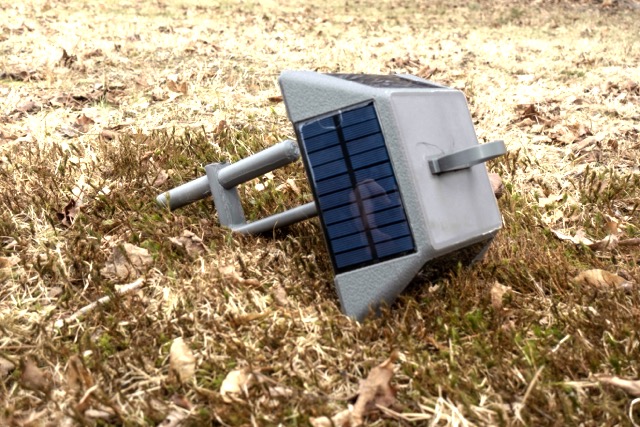
Shows the relay hanging outdoors with the lower stake assembly visible beneath the enclosure.

Hardware
Top hanging loop detail
A close crop of the top loop and roof cap so you can inspect exactly how the node hangs in the field.

Charging side
Solar panel face and access door
Puts the charging surface and service door in one frame for a practical look at the enclosure exterior.
Mounting detail
Rear base and lower stake assembly
Documents the tapered base and the lower mounting hardware that support the relay in the field.
Power system
Single-cell 6.8 Ah battery compartment
Confirms the serviceable 6.8 Ah / 6800 mAh one-cell battery layout, which avoids the cell-balancing requirements of a multi-cell pack.

Electronics
Control board and wiring
Shows the internal board stack and wiring layout so the service path feels inspectable, not hidden.

RF routing
Antenna cable and battery leads
A tighter interior crop focused on cable routing and the kind of details that matter during field maintenance.
Overview
The RAK4631 Solar Mesh Relay is designed for buyers who need finished outdoor relay hardware rather than assembling a custom enclosure. It combines the RAK4631 platform with four integrated 6V 200 mA solar panels, a top-mount form factor, and a serviceable internal layout for long-term field deployment.
The solar array is built from four 6V 200 mA panels and delivers roughly 3-5W of charging in optimal conditions, and the relay ships with MeshCore installed so setup can focus on placement, power, and configuration. It is well suited for neighborhood coverage extension, trail access points, property boundaries, and other fixed outdoor relay placements.
- RAK4631-based radio platform
- MeshCore installed before shipment
- Fixed dipole antenna for consistent field performance
- Single 6.8 Ah / 6800 mAh 26650 battery design
- Four 6V 200 mA solar panels for roughly 3-5W optimal solar charging charging
- Serviceable enclosure and accessible internals
- Supports OTA updates
Why a fixed dipole antenna?
For a relay that remains in one outdoor location, predictability matters more than compact size. A whip monopole depends more heavily on the surrounding ground plane and installation details, which can introduce additional variability in the field.
The fixed dipole antenna is more self-contained, making performance easier to reproduce from one deployment to the next. That makes it a practical choice for a permanent outdoor relay where consistent coverage matters more than portability.
Why a single 6.8 Ah / 6800 mAh 26650 battery?
This design favors serviceability over pack complexity. A single large-format 26650 cell reduces holders, interconnects, welds, and battery-management overhead while avoiding the balancing considerations that come with multi-cell packs.
That matters because cell imbalance in a multi-cell pack can reduce usable runtime, accelerate uneven aging, and push weaker cells to overvoltage or undervoltage limits before the rest of the pack. A single-cell design avoids that inter-cell balancing problem entirely while keeping battery replacement more straightforward over the life of the product.
Recommended applications
This relay is intended for buyers building neighborhood, trail, property, and off-grid coverage who want the RAK4631 platform in a deployment-ready outdoor enclosure. It is especially relevant for anyone comparing outdoor mesh nodes, solar LoRa relays, or serviceable repeater hardware.
It also fits buyers who recognize the RAK4631 hardware stack from adjacent mesh ecosystems. The unit ships configured for MeshCore, while still offering a familiar hardware platform for comparison and evaluation.
What ships and what to expect
This product is a finished outdoor relay node rather than a bare radio board. Core product highlights include MeshCore installed before shipment, a fixed dipole antenna, a 6.8 Ah / 6800 mAh single-cell 26650 service path, and a serviceable enclosure architecture.
Field performance will still depend on installation height, local RF conditions, solar exposure, and deployment choices, but the design is intended to reduce the effort required to move from purchase to deployment.
Sources
External references for the hardware claims on this page.
These references sit below the sales copy so the page stays focused on the node itself while still showing where the hardware and comparison details came from.
MeshCore FAQ
Meshtastic Introduction
RAKwireless RAK4631 product page
Pack Team Power SW26650-70HP battery page
Semtech SX1262 product page
RAKwireless WisMesh solar repeater product page
Texas Instruments AN058 antenna selection guide
Texas Instruments battery cell balancing overview
Texas Instruments cell balancing considerations
Analog Devices active battery cell balancing